Small Business Growth & Strategy
Pro Bono Consulting Case Study | Website Assessment, Market Positioning & Customer Acquisition
The Engagement
A small Ontario-based commercial services business was looking to strengthen its online presence and attract new customers in a competitive market.
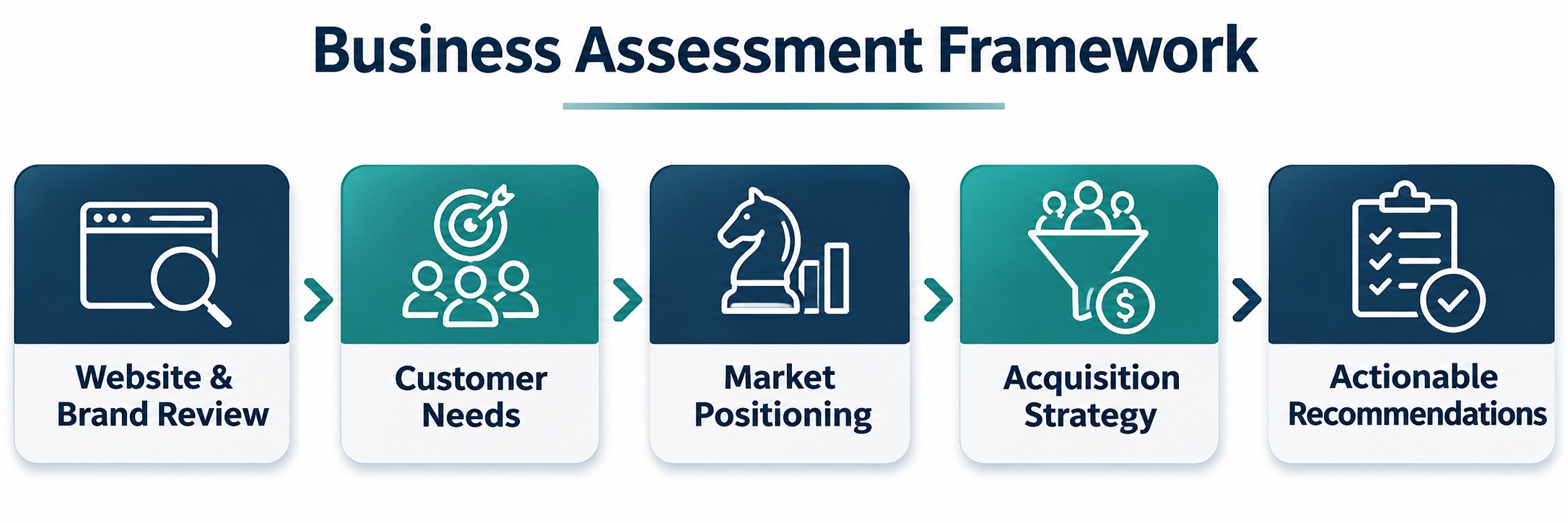
I provided a pro bono consulting assessment focused on three areas:
-
Evaluating the company’s website and customer-facing messaging.
-
Identifying opportunities to improve credibility, differentiation, and market positioning.
-
Developing practical customer acquisition and business development strategies.
The objective was to identify improvements that a small business could realistically implement without requiring a substantial marketing budget or additional staff.
Rather than treating this exclusively as a website design exercise, I approached it as a broader business problem: How does a small service provider build trust, communicate its value, and compete for customers against more established organizations?
The Challenge: Being Found Is Only Half the Problem
Small businesses often invest time and money in creating a website but overlook an important question:
Does the website give prospective customers a compelling reason to choose the business?
In this engagement, the company had an established online presence describing the services it offered. However, several aspects of the website and marketing approach created opportunities for improvement.
The business operated in a competitive service industry where prospective customers were likely to compare several providers before making a decision.
Simply listing available services wasn’t enough.
The company needed to communicate reliability, professionalism, consistency, and the practical benefits customers could expect.
The challenge extended beyond the website. The business also needed realistic ways to identify prospective customers, initiate conversations, and convert those conversations into commercial opportunities.
1. Evaluating the Website Through the Customer’s Eyes
I began by reviewing the website from the perspective of a prospective customer unfamiliar with the business.
My assessment focused on navigation, messaging, brand consistency, credibility, and the effectiveness of its calls to action.
Several opportunities emerged.
Brand Consistency
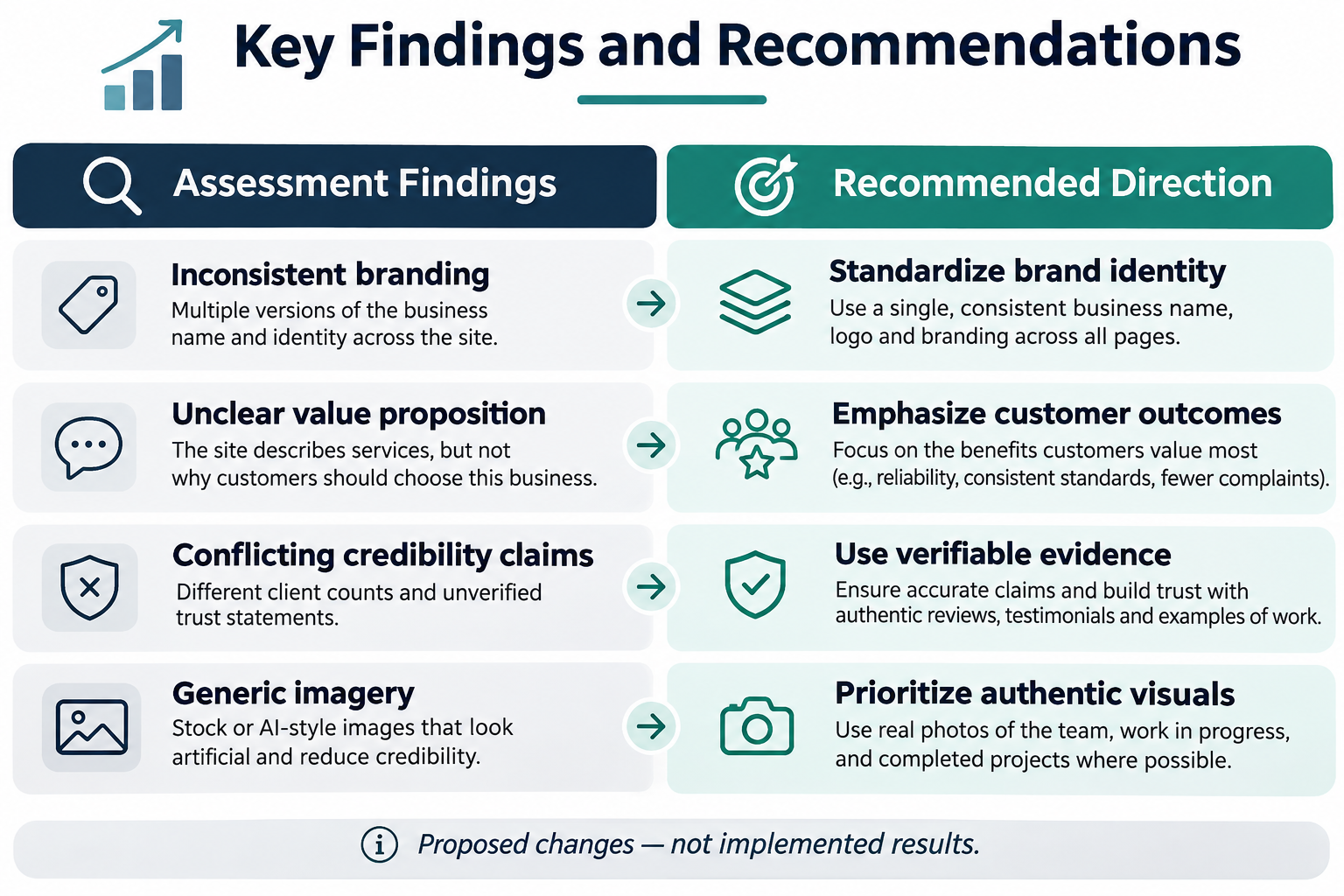
The website presented variations in the company’s business name and branding.
Although these differences might seem minor, inconsistent branding can create uncertainty for prospective customers.
I recommended standardizing the company name, visual identity, and business information across the website.
Credibility and Trust
The website included customer-count claims that were inconsistent across different sections.
For a prospective customer evaluating an unfamiliar service provider, conflicting information can undermine confidence.
I recommended reviewing these claims for accuracy and supporting credibility statements with verifiable evidence, such as authentic customer reviews, testimonials, and examples of completed work where permission was available.
Visual Presentation
Some promotional images appeared artificial and didn’t effectively demonstrate the company’s capabilities.
I recommended prioritizing authentic imagery of actual work, facilities, equipment, and team members where available.
The goal wasn’t simply to make the website more attractive. It was to make the business more credible.
Clearer Value Proposition
One of my central observations was that the website primarily explained what services the company offered.
It did less to explain why a customer should choose that company over its competitors.
For a commercial services provider, customers aren’t simply purchasing individual tasks.
They’re looking for reliable service delivery, consistent standards, responsive communication, and fewer operational headaches.
I recommended shifting the messaging away from generic service descriptions toward the outcomes and benefits customers value.
2. Strengthening Market Positioning
The next stage focused on helping the business communicate its value to different types of customers.
Rather than treating every prospective customer as part of one broad market, I recommended developing more focused messaging for specific customer segments.
These included commercial property managers, offices, medical and dental clinics, educational facilities, and businesses requiring specialized or periodic services.
Different customers have different priorities.
A property manager may care about tenant complaints, service consistency, and contract reliability.
A medical office may prioritize appropriate cleaning procedures, scheduling, and operational disruption.
A small office may be more concerned with affordability, after-hours availability, and responsiveness.
I recommended creating dedicated website content addressing the needs of each customer segment.
This would help prospective customers understand not only what the company offered, but how its services could address their particular challenges.
3. Building a Practical Customer Acquisition Strategy
Improving the website was only one part of the engagement.
The business also needed a practical strategy for identifying and approaching prospective customers.
I developed recommendations across several customer acquisition channels.
Targeted Prospecting
Rather than relying exclusively on broad advertising, I recommended focusing on identifiable customer segments and decision-makers.
Potential targets included property management companies, small commercial facilities, independent clinics, and local businesses.
I researched relevant industry associations, business directories, and publicly available sources that could help identify prospective customers.
The objective was to make prospecting more structured and focused.
Consultative Selling
I recommended approaching prospective customers by understanding their existing service challenges rather than immediately presenting a sales pitch.
For example, instead of asking a property manager whether they needed a new service provider, the conversation could begin by exploring what wasn’t working with their current arrangements.
This approach shifts the discussion away from competing exclusively on price and toward identifying operational problems the business might be able to solve.
Reducing the Risk of Switching Providers
Changing service providers creates uncertainty for customers.
Even when a prospective customer is dissatisfied with an existing vendor, they may hesitate to make a change.
I suggested exploring appropriately structured trial arrangements, site assessments, and clearly defined service commitments to reduce that perceived risk.
These recommendations were intended to make it easier for prospective customers to evaluate the company’s capabilities before entering into longer-term commitments.
4. Exploring Partnerships and Subcontracting Opportunities
Another part of the assessment focused on alternative ways to generate business while building a customer base.
For a small service provider, winning large commercial contracts directly can be difficult, particularly without an extensive operating history or established references.
I recommended investigating subcontracting and overflow opportunities with larger service providers.
These arrangements could potentially help the business:
-
Access work without relying entirely on direct customer acquisition.
-
Develop operational experience with commercial accounts.
-
Build professional relationships and references.
-
Generate opportunities for recurring work.
I also researched established businesses and potential vendor programs that might be worth approaching.
These were identified as prospective opportunities, not confirmed partnerships or contract awards.
The broader recommendation was to diversify business development efforts rather than depend on one acquisition channel.
5. Making Recommendations Practical and Actionable
One consideration throughout the engagement was the company’s likely resource constraints.
It’s easy to recommend a complete website redesign, extensive advertising campaigns, or sophisticated sales technology.
But those suggestions aren’t particularly useful if a small business lacks the budget or capacity to implement them.
My recommendations focused on practical changes that could be introduced incrementally.
Some involved relatively straightforward website updates, such as correcting inconsistent messaging and improving calls to action.
Others required more sustained effort, including creating customer-segment content, establishing prospecting routines, and building relationships with potential business partners.
I also recommended introducing website analytics to better understand how prospective customers discovered and interacted with the business.
The goal was to provide a realistic starting point rather than an expensive transformation program.
The Deliverable
The engagement resulted in an 11-page advisory document containing:
-
A detailed website and brand assessment.
-
Recommendations for improving credibility and customer messaging.
-
Market segmentation and positioning opportunities.
-
Practical customer acquisition strategies.
-
Examples of prospecting and outreach approaches.
-
Potential subcontracting and partnership opportunities.
-
Relevant industry resources and lead sources.
The document was intended to give the business owner a practical set of recommendations they could review, prioritize, and implement according to their available resources.
Engagement Outcome and Limitations
The completed assessment and recommendations were provided as a pro bono consulting engagement.
The business did not provide subsequent implementation updates, so I cannot independently verify which recommendations were adopted or whether they produced measurable commercial results.
Accordingly, this case study documents the assessment, strategic recommendations, and advisory deliverables, rather than claiming a completed business transformation.
What This Engagement Demonstrates
While much of my professional experience has involved leading customer operations and technical support organizations, the underlying skills are transferable across industries.
This engagement allowed me to apply several of those capabilities in a small-business environment:
Business Analysis: Evaluating an existing operation, identifying weaknesses, and distinguishing symptoms from underlying problems.
Customer-Centric Thinking: Looking beyond what a business sells to understand what its customers actually value.
Process Improvement: Identifying practical changes that can improve consistency, credibility, and operational effectiveness.
Strategic Planning: Developing recommendations that account for competitive conditions, available resources, and implementation constraints.
Business Development: Researching potential customers, identifying acquisition opportunities, and recommending structured outreach approaches.
My Approach to Consulting
One of the things I enjoy most about consulting is the opportunity to look at a problem from a fresh perspective.
Sometimes organizations become so familiar with their existing processes and ways of working that potential improvements are difficult to recognize.
An outside perspective can help identify those opportunities.
My approach is straightforward: understand the problem, examine the evidence, identify practical improvements, and recommend actions appropriate to the organization’s needs and resources.
Whether I’m working with a technical support department or a small business trying to attract more customers, the principle remains the same.
Good consulting isn’t about delivering the longest report. It’s about identifying the right problems and providing recommendations people can realistically act upon.
This case study has been anonymized to respect the business owner’s privacy. No implementation outcomes or commercial results are claimed.
Interested in discussing operational improvement or business consulting?
contact@mohamedbhimji.com
mohamedbhimji.com