The Fourth Gate of AI Readiness in Customer Operations
In Gate 1, we defined the operational constraint.
In Gate 2, we evaluated the structural integrity of our data.
In Gate 3, we formalized ownership and accountability.
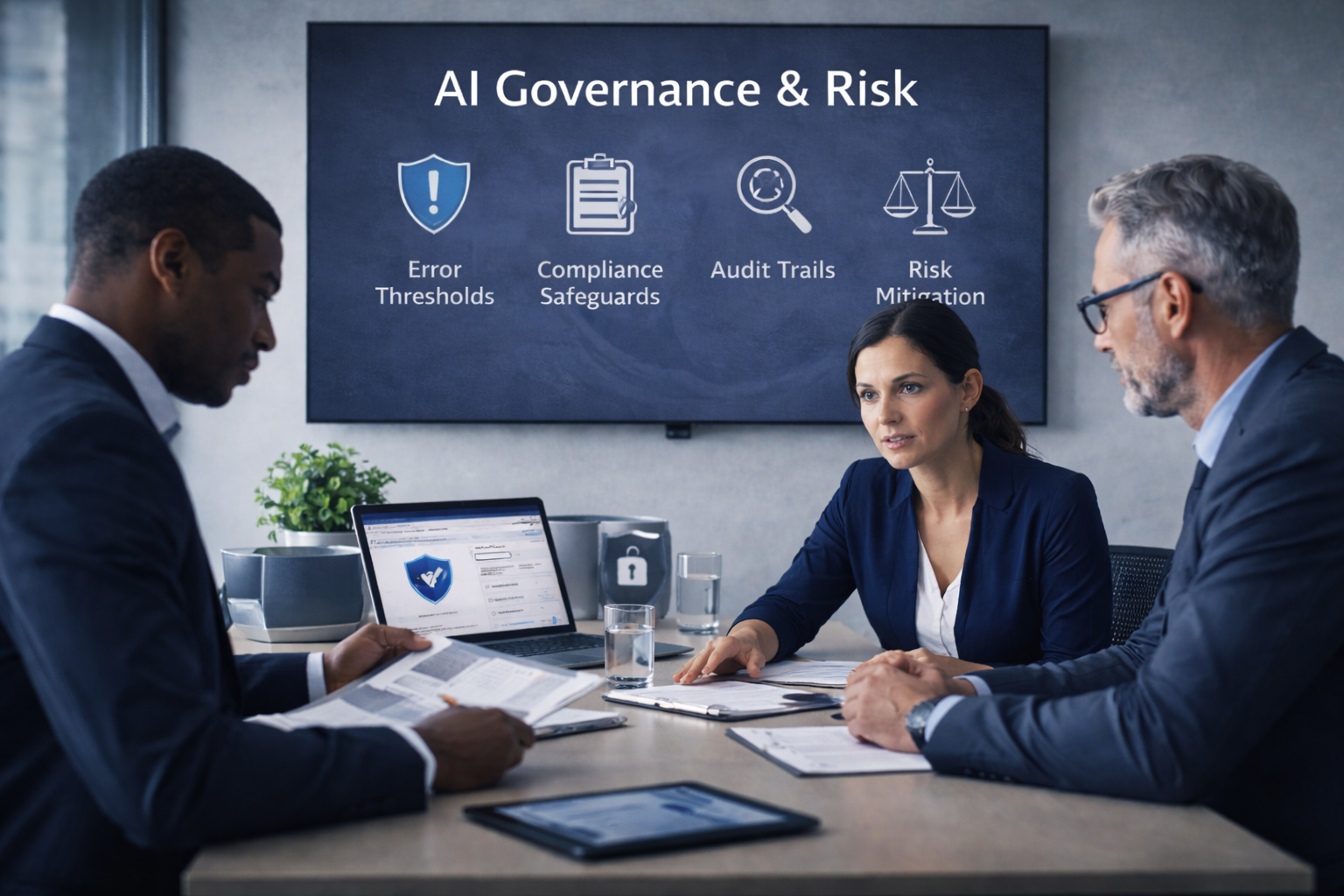
Gate 4 addresses the dimension that determines long-term sustainability: risk governance.
AI introduces operational leverage. It also introduces exposure. When automation expands decision velocity, the impact of small errors compounds quickly. Without structured guardrails, organizations can reduce visible workload while increasing invisible risk.
Gate 4 ensures that efficiency does not outpace oversight.
The Nature of AI Risk in Customer Operations
Risk in Customer Operations is rarely dramatic at first. It emerges incrementally.
An automated response resolves 92 percent of inquiries correctly, but the remaining 8 percent represent high-value customers whose frustration carries disproportionate financial impact. A triage model reduces handle time but introduces subtle misclassification patterns that shift workload upstream. A summarization engine streamlines documentation yet omits context that later proves relevant in compliance review.
These issues are not technological failures. They are governance gaps.
AI changes the operating model. It inserts probabilistic decision-making into workflows that were previously deterministic and human-reviewed. That shift requires explicit tolerance definitions, escalation thresholds, and override mechanisms.
Without these structures, organizations rely on reactive correction rather than preventive design.
Defining Acceptable Error Thresholds
No AI system operates at 100 percent accuracy. Mature organizations acknowledge this reality early and define acceptable error thresholds based on customer segment, ticket type, and business risk.
For example, automated containment for low-complexity billing inquiries may tolerate a higher margin of error than automated responses for enterprise security incidents. Error tolerance must be contextual rather than uniform.
Leadership should be able to answer:
- What accuracy threshold must be maintained before expansion?
- Which customer segments require stricter containment standards?
- At what point does automation revert to human intervention?
- How are false positives and false negatives tracked?
Without quantified thresholds, performance discussions become subjective and politically negotiated.
Human Override and Escalation Safeguards
Automation should never eliminate the capacity for human judgment. It should augment it.
Gate 4 requires explicit override pathways that allow agents or customers to bypass automation when necessary. These safeguards must be frictionless and clearly communicated. If escalation requires excessive effort, customers remain trapped within flawed automation loops.
Additionally, internal escalation logic should be documented and auditable. When AI-driven triage routes tickets between tiers, organizations must be able to trace the rationale behind routing decisions. Transparency is not only a compliance requirement in certain industries; it is an operational necessity for trust.
Human-in-the-loop design is not a defensive posture. It is a structural safeguard that preserves accountability.
Transparency and Auditability
As AI becomes embedded within workflows, leadership must ensure that decision logic remains observable.
This includes:
- Documented model purpose and scope
- Version control for deployed models
- Clear articulation of training data sources
- Monitoring for performance drift
- Periodic impact audits across customer segments
Auditability extends beyond compliance requirements. It protects organizational credibility. When stakeholders question automation decisions, the organization must be able to explain not only what happened, but why.
Opacity erodes trust internally and externally.
Compliance and Regulatory Considerations
Depending on the industry, AI deployment in Customer Operations may intersect with privacy regulations, consumer protection standards, financial disclosure rules, or sector-specific compliance frameworks.
Organizations must assess:
- Whether customer data used for training is properly governed
- Whether automated decisions influence contractual commitments
- Whether response generation introduces legal or brand risk
- Whether regulatory reporting obligations are affected by automation
Compliance review should occur before expansion, not after incident response.
AI governance is strongest when Legal and Risk stakeholders are integrated early into the design process rather than consulted retroactively.
Monitoring for Drift and Unintended Consequences
AI systems evolve as input data evolves. Product changes, customer behavior shifts, and ticket mix fluctuations alter model performance over time. Without structured monitoring, drift can go undetected.
Governance should include:
- Scheduled performance reviews
- Segment-based accuracy tracking
- Reopen and escalation trend analysis
- Customer effort monitoring
- Bias detection reviews
Drift is rarely dramatic. It is gradual. The absence of monitoring creates the illusion of stability while performance quietly degrades.
The Gate Test
Before passing Gate 4, leadership should be able to state with confidence:
- Acceptable error thresholds are defined by segment and risk category.
- Human override pathways are embedded and measurable.
- Escalation safeguards are documented and auditable.
- Model versions and changes are tracked systematically.
- Compliance and legal considerations have been formally reviewed.
- Ongoing monitoring for performance drift is institutionalized.
If these mechanisms are informal, personality-driven, or reactive, governance maturity remains incomplete.
AI should scale only when guardrails scale alongside it.
Closing the Framework
With a defined constraint, disciplined data, clear ownership, and structured governance, AI transitions from experiment to capability.
Organizations that pass all four gates do not simply deploy automation. They redesign how Customer Operations functions, measures impact, and manages risk.
The temptation is always to move quickly. Mature organizations move deliberately. They recognize that automation without governance does not reduce risk; it redistributes it.
AI readiness is not about speed. It is about control.
Keywords
AI risk management, AI governance framework, enterprise AI compliance, AI oversight strategy, responsible AI in customer operations