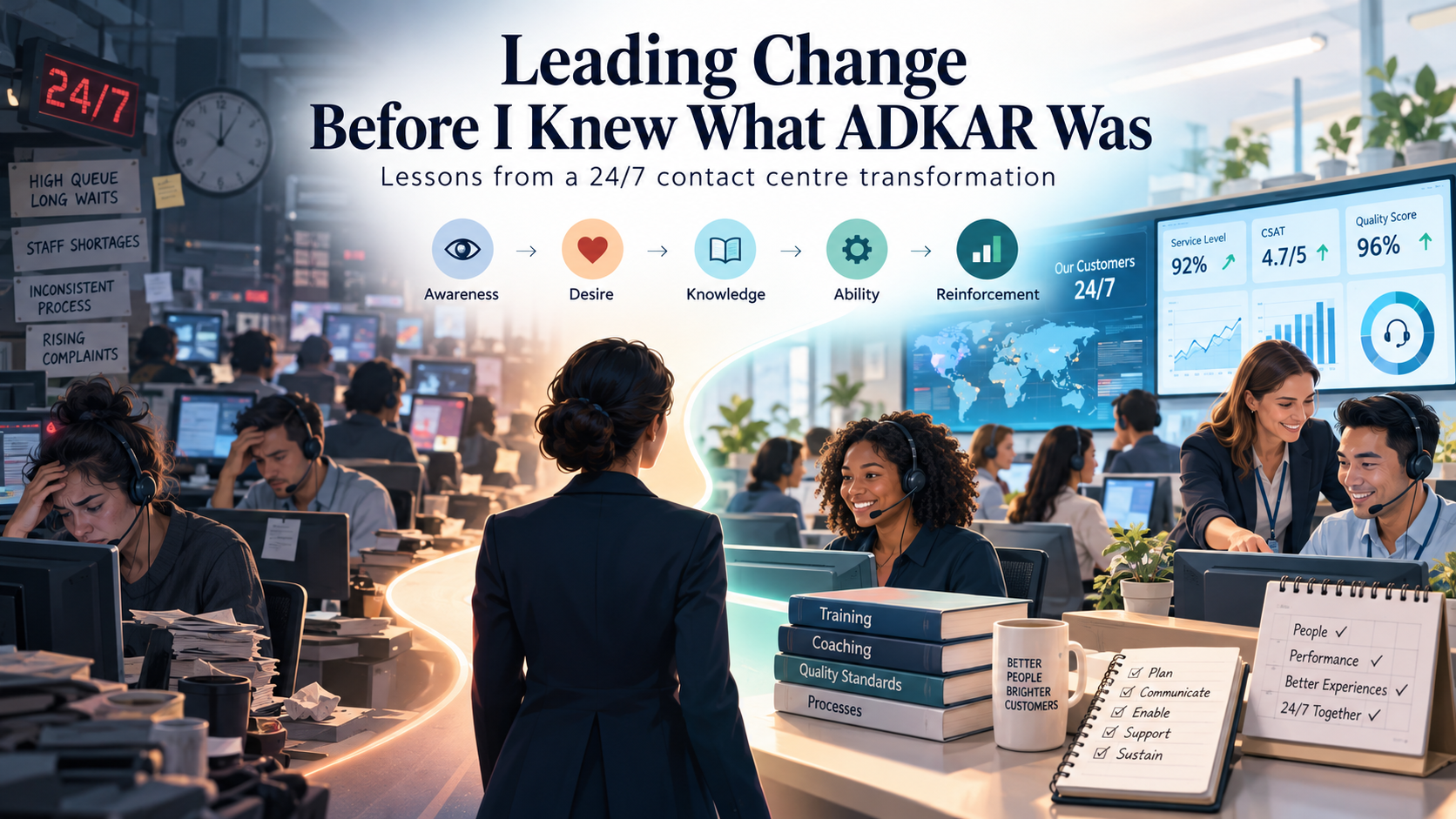
How three operational changes in a 24/7 contact centre taught me that successful transformation is as much about people as it is about processes.
Years ago, while serving as Director of Customer Support & Field Operations at InComm, I led a series of changes affecting a 25-person, 24/7 contact centre.
At the time, I wasn’t familiar with the Prosci ADKAR framework. I wasn’t consciously following a formal change-management methodology. I was trying to solve operational problems that were affecting service consistency, management efficiency, and employee accountability.
Looking back, I recognize many of the principles behind ADKAR in the approach we took, along with a few important lessons about what we could have done better.
The Challenge: Changing an Established Way of Working
When I took responsibility for the operation, several fundamental processes needed attention.
Employee schedules rotated regularly, requiring management to spend one to two weeks each month rebuilding schedules and resolving conflicts. There was no formal quality assurance program, no consistent performance evaluation process, and limited standardized training.
Employees had become accustomed to considerable flexibility and autonomy. Introducing structure meant changing arrangements they had lived with for years.
Over approximately three months, we introduced three significant changes:
-
A shift-bidding process based on seniority.
-
Permanent schedules to replace rotating shifts.
-
A formal quality assurance and employee development program.
Each initiative made operational sense. None was particularly easy to introduce.
When Operational Improvements Feel Like Threats
One of the biggest lessons was discovering how differently employees and management could view the same change.
From a management perspective, permanent schedules would reduce administrative effort, improve staffing consistency, and allow employees to plan their personal lives further ahead.
From an employee’s perspective, permanent schedules initially meant losing the ability to rotate into more desirable shifts.
Shift bidding introduced another concern: fairness. Would senior employees always get the best schedules? Would management show favouritism? What happened when someone left? And what about the people working nights?
The QA program generated even greater anxiety.
Employees who had never been formally evaluated suddenly faced scorecards, call reviews, and performance expectations. Many feared the program was being introduced to identify employees for termination.
That was never the intention, but the perception mattered.
A change can be operationally sound and still fail if employees don’t understand or trust why it’s happening.
Moving from Resistance to Acceptance
We introduced shift bidding with clear rules based on tenure, opportunities to bid again when vacancies occurred or during the annual process, and the ability to exchange shifts with colleagues.
Once the permanent schedules were operating, employees began recognizing benefits they hadn’t initially anticipated.
They knew their working hours. They could plan medical appointments, school commitments, and family responsibilities without wondering what their next month’s schedule would look like.
The QA program followed a similar path.
We introduced structured scorecards, call evaluations, coaching, and standardized training. We also established recognition and performance incentives, rather than positioning quality assurance solely as a disciplinary process.
Over time, employees could see that the program was intended to recognize good performance, identify areas for improvement, and provide practical support.
We also developed a more structured onboarding approach. New employees could begin handling basic calls within approximately two weeks, compared with an onboarding process that had previously taken months.
The initial resistance gradually gave way to acceptance as employees experienced the benefits firsthand.
Where ADKAR Comes In
The Prosci ADKAR model describes five outcomes necessary for successful individual change:
Awareness, Desire, Knowledge, Ability, and Reinforcement.
Although we weren’t formally using that framework, the experience reflected several of its principles.
Employees needed to understand why the changes were necessary. They needed reasons to participate, clear guidance on the new processes, opportunities to develop the necessary skills, and ongoing support to make the changes stick.
The most important lesson, however, came from recognizing where my approach could have been better.
What I Would Do Differently Today
I would communicate more, listen earlier, and pay greater attention to what employees were saying outside formal meetings.
We held team meetings and explained what was changing and how the new processes would work. At the time, I believed we had communicated sufficiently.
Looking back, I hadn’t paid enough attention to the informal conversations happening between employees.
Those conversations often revealed concerns that weren’t being raised directly with management.
When employees were worried about fairness, losing flexibility, or even losing their jobs, explaining the mechanics of a new process wasn’t enough. We also needed to address the underlying uncertainty.
This is where understanding ADKAR today gives me a better perspective on the experience.
Providing knowledge about a change doesn’t necessarily create awareness of why it’s needed, and neither automatically creates a desire to support it.
The Leadership Lesson
We achieved meaningful improvements in scheduling, quality assurance, and employee onboarding. The changes also gave employees more predictability and created clearer expectations across the operation.
But the experience reinforced something I’ve carried throughout my leadership career:
Successful change isn’t just about designing a better process. It’s about helping people become comfortable enough with that change to make it work.
I didn’t know the ADKAR framework when I led these initiatives. Learning about it later helped me put structure and language around lessons I had gained through experience.
And perhaps most importantly, it helped me recognize what I would do differently the next time.
In a companion case-study presentation, I’ll break down these three initiatives using the five ADKAR elements, including the resistance we encountered, how we responded, and the lessons I took away from the experience.
Recommended to view the case study in full-screen mode. Click the full screen icon 3rd from the right just below the document window.
Learn more about ADKAR by visiting the Prosci official ADKAR model.